
Have you ever received a text saying yes yes and wondered why someone repeated the word instead of simply saying yes It might look like a small ordinary response but in texting repeating a word can sometimes communicate more than you expect.
Whether you’re chatting with a friend talking to someone you like or discussing something important the phrase yes yes can carry different meanings depending on the conversation.
Sometimes it shows excitement. Other times it simply confirms that someone understands you. It can even sound impatient sarcastic or slightly dismissive.
So what does yes yes mean in text and how can you tell what someone really means
Let’s break it down with simple explanations everyday examples and useful texting tips.
What Does Yes Yes Mean in Text?
Yes yes in text usually means strong agreement, confirmation, understanding, or enthusiasm. When someone repeats “yes,” they may be emphasizing their agreement or showing that they are actively listening.
For example:
- “Yes yes, I understand!” means the person understands what you’re saying.
- “Yes yes, let’s go!” expresses excitement and agreement.
- “Yes yes, I’ll do it” confirms that the person agrees to complete something.
However, the meaning isn’t always positive. Depending on the conversation, repeating “yes” can also suggest impatience or sarcasm.
The best way to understand the message is to consider the conversation, the relationship, and the person’s usual texting style.
Yes Yes Meaning in Simple Words
In simple words, “yes yes” means “I agree,” “I understand,” or “definitely.”
It’s a casual way of responding when someone wants to emphasize their answer.
Think of it this way:
- Yes: A simple confirmation.
- Yes yes: A stronger or more expressive confirmation.
- Yes, yes!: Often shows excitement or enthusiasm.
- Yes yes…: Can sometimes suggest hesitation, impatience, or sarcasm.
The repeated word adds emphasis, but it doesn’t automatically mean the person feels more strongly about something.
For instance, if your friend asks whether you are coming to a party and you reply “Yes yes!”, you’re confirming that you’re coming and may sound excited.
Where Is Yes Yes Used?
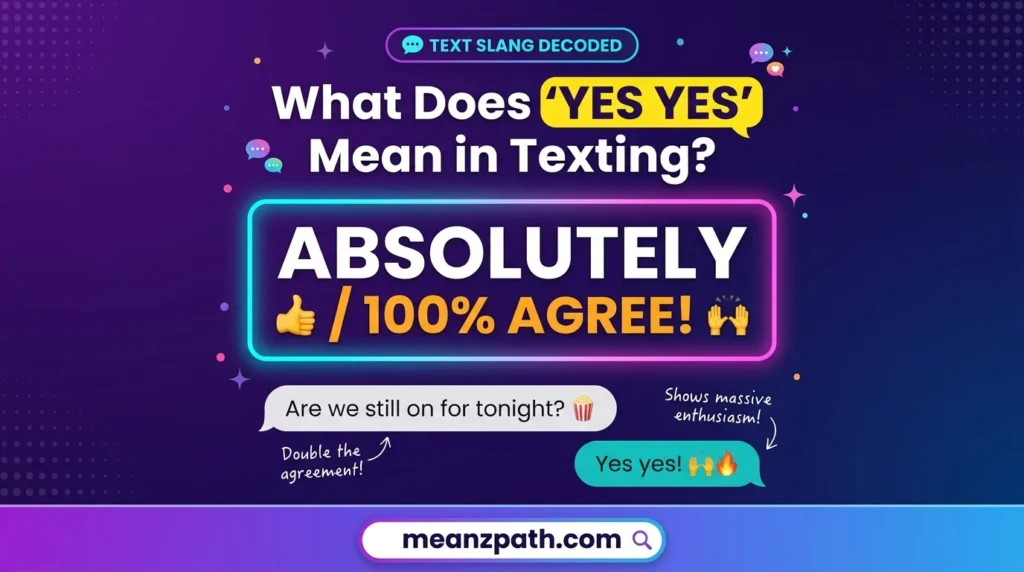
The phrase “yes yes” is common in casual digital communication. People use it in different situations when they want to agree, confirm information, or keep a conversation moving.
Here are some places where you might see it.
1. WhatsApp
On WhatsApp, people often use “yes yes” to respond quickly to questions or confirm plans.
Example:
Friend: Are you coming over tonight?
You: Yes yes, I’ll be there!
Here, the repeated yes makes the response sound friendly and enthusiastic.
2. Instagram and Snapchat
On social media, “yes yes” can appear in direct messages when people agree with opinions, react to pictures, or respond to suggestions.
Example:
Person A: This outfit looks amazing!
Person B: Yes yes, absolutely!
It communicates agreement and excitement.
3. TikTok Comments
People sometimes use “yes yes” in TikTok comments to show support for an opinion, trend, or funny video.
Example:
Comment: We need more videos like this!
Reply: Yes yes! 🔥
The phrase adds energy and makes the response feel more enthusiastic.
4. Casual Conversations With Friends
Friends may use repeated words naturally without thinking much about them.
Example:
Friend: Don’t forget to bring your headphones.
You: Yes yes, I won’t forget.
Here, the phrase simply confirms that you’ve heard the reminder.
5. Romantic Text Conversations
In romantic conversations, “yes yes” can sometimes sound playful, affectionate, or excited.
Example:
Partner: Do you want to see me tomorrow?
You: Yes yes, can’t wait! ❤️
In this situation, the phrase communicates enthusiasm about spending time together.
Why Do People Say Yes Yes in Text?
There are several reasons someone might repeat the word yes instead of using a single response.
1. To Show Strong Agreement
One of the most common reasons is to emphasize agreement.
When someone says “yes yes,” they may want to make it clear that they agree with your suggestion or opinion.
Example:
You: We should try that new restaurant.
Friend: Yes yes, definitely!
The response sounds more expressive than a simple “yes.”
2. To Show Excitement
Sometimes people repeat yes because they’re genuinely excited.
For example:
You: Guess what? We got the tickets!
Friend: Yes yes! That’s amazing!
Here, the repeated word communicates happiness and enthusiasm.
3. To Confirm Understanding
People also use “yes yes” when they understand instructions or information.
Example:
Manager: Please send me the document before 5 PM.
Employee: Yes yes, understood.
The response confirms that the instructions have been received.
4. To Sound Friendly and Casual
A single “yes” can sometimes feel formal or short.
Adding another yes can make the conversation feel more relaxed and natural, depending on the person’s communication style.
5. To Show Impatience
Not every repeated yes is enthusiastic.
Sometimes someone repeats it because they feel that you’ve explained something several times.
Example:
You: Remember, the meeting starts at 9 AM.
Friend: Yes yes, I know!
The response may suggest that the person is getting slightly annoyed.
6. To Use Humor or Sarcasm
People sometimes repeat words to create a funny or sarcastic effect.
Example:
You: I’m always right!
Friend: Yes yes, you’re the smartest person ever. 😂
Here, the response is probably playful rather than a serious compliment.
Real-Life Examples of Yes Yes in Text
The easiest way to understand this expression is to look at how people actually use it in conversations.
Here are some everyday examples.
Example 1: Agreeing With a Friend
Alex: Let’s watch a movie tonight.
Sam: Yes yes, I’m in!
Meaning: Sam agrees with the plan and sounds enthusiastic.
Example 2: Confirming Information
Mom: Did you finish your homework?
You: Yes yes, I finished everything.
Meaning: You’re confirming that the work is complete.
Example 3: Showing Excitement
Friend: We’re going shopping tomorrow!
You: Yes yes! I’ve been waiting for this!
Meaning: You’re happy and excited about the plan.
Example 4: A Romantic Conversation
Partner: Do you miss me?
You: Yes yes, so much! ❤️
Meaning: You’re expressing affection and confirming that you miss them.
Example 5: Showing Impatience
Friend: Don’t forget to call me when you arrive.
You: Yes yes, I heard you.
Meaning: Depending on the tone, this could suggest that you’ve already understood and don’t need another reminder.
Example 6: A Sarcastic Response
Friend: I’m the funniest person in this group.
You: Yes yes, obviously! 😂
Meaning: You’re probably teasing your friend rather than seriously agreeing.
Example 7: A Professional Conversation
Coworker: Can you review the report today?
You: Yes yes, I’ll check it this afternoon.
Meaning: You’re confirming that you’ll review the report.
Example 8: Agreeing With an Opinion
Person A: Coffee makes every morning better.
Person B: Yes yes, 100%!
Meaning: Person B strongly agrees with the opinion.
Yes Yes vs. Similar Texting Expressions
Although several texting expressions communicate agreement, their tone and meaning can be slightly different.
Here’s a quick comparison:
| Expression | Meaning | Common Tone |
|---|---|---|
| Yes | Simple agreement | Neutral |
| Yes yes | Emphasized agreement | Friendly or enthusiastic |
| Yeah yeah | Casual agreement | Relaxed or impatient |
| Yup | Informal confirmation | Casual |
| Absolutely | Strong agreement | Confident |
| Definitely | Clear confirmation | Positive |
| Of course | Agreement or reassurance | Friendly |
| Sure sure | Agreement or acknowledgment | Casual or dismissive |
| Yesss! | Excited agreement | Enthusiastic |
Yes Yes vs. Yeah Yeah
“Yes yes” often communicates agreement or understanding, while “yeah yeah” is generally more casual.
However, both can sound impatient if someone uses them to end a conversation quickly.
Yes Yes vs. Yup
“Yup” is a short, informal way to say yes.
“Yes yes” usually adds emphasis or makes the response more expressive.
Yes Yes vs. Yesss
“Yesss” often expresses excitement, happiness, or celebration.
“Yes yes” can communicate excitement too, but it is also commonly used for ordinary confirmation.
When Should You Use Yes Yes?
You can use “yes yes” in everyday texting when you want to sound friendly, expressive, or enthusiastic.
Here are some situations where it works naturally:
- When agreeing with friends: “Yes yes, let’s do it!”
- When confirming plans: “Yes yes, I’ll meet you there.”
- When showing excitement: “Yes yes! I’m so happy!”
- When acknowledging instructions: “Yes yes, I understand.”
- When responding playfully: “Yes yes, you’re always right! 😂”
- When supporting someone’s opinion: “Yes yes, I completely agree.”
When Should You Avoid Using It?
Although the expression is common in casual conversations, it isn’t suitable for every situation.
Avoid using it when:
- Writing a formal business email.
- Responding to serious or sensitive news.
- Communicating with someone who prefers professional language.
- You want to avoid sounding impatient or dismissive.
- A simple, clear confirmation would be more appropriate.
For professional situations, expressions like “Understood,” “Certainly,” and “Yes, I agree” may be better choices.
Common Misunderstandings About Yes Yes
Because texting doesn’t include voice or facial expressions, people sometimes misunderstand repeated words.
Let’s clear up a few common misconceptions.
1. It Doesn’t Always Mean Excitement
Some people think “yes yes” always means someone is excited.
That’s not necessarily true. It can simply be a way to confirm something.
2. It Doesn’t Always Mean Impatience
Repeated yes can sometimes sound annoyed, but it isn’t automatically rude.
Many people naturally repeat words when texting.
3. It Isn’t Always Romantic
If someone sends you “yes yes,” it doesn’t automatically mean they’re flirting.
The phrase is commonly used between friends, family members, and coworkers.
4. It Doesn’t Always Mean Strong Agreement
Sometimes people use “yes yes” just to acknowledge a message without expressing a strong opinion.
For example, someone might reply “Yes yes” simply because they want you to know they’ve read your message.
5. Punctuation Can Change the Tone
Compare these messages:
- “Yes yes!” — Often enthusiastic.
- “Yes yes.” — Can sound straightforward or slightly firm.
- “Yes yes…” — May suggest hesitation or impatience.
- “Yes yes 😂” — Usually playful or humorous.
Remember that punctuation isn’t a reliable way to identify someone’s feelings. Always consider the surrounding conversation.
Pro Tips: How to Understand What Someone Really Means
If someone sends you “yes yes,” don’t immediately assume they’re excited, annoyed, or flirting.
Use these practical tips to understand their intention.
1. Read the Previous Message
Look at what you asked before receiving the response. If you suggested a fun activity, the answer might show excitement. If you repeated an instruction, it might indicate impatience.
2. Consider Your Relationship
A close friend may use repeated words playfully, while a coworker might use them simply to confirm information.
3. Notice Their Usual Texting Style
Some people repeat words frequently. If someone always uses expressions like “yes yes,” “okay okay,” or “sure sure,” it may simply be their communication habit.
4. Look at Emojis
Emojis can provide additional context.
- ❤️ can suggest affection.
- 😂 often suggests humor.
- 🔥 can express excitement.
- 🙄 may indicate annoyance or sarcasm.
However, emojis also depend on personal texting habits.
5. Don’t Overthink Short Replies
A two-word message doesn’t always hide a deeper meaning. Sometimes “yes yes” simply means yes!
If you’re genuinely unsure, you can politely ask what the person means.
Next time someone sends you “yes yes,” you’ll have a much better idea of what they might be trying to say! 😊
FAQs:
1. What does yes yes mean from a girl?
When a girl texts “yes yes,” she usually means she agrees, understands, or confirms something. Depending on the conversation, it may also express excitement or playfulness. It doesn’t automatically mean she is flirting.
2. Is saying yes yes rude?
No, “yes yes” isn’t inherently rude. It’s usually a casual way to express agreement or acknowledgment. However, in certain situations, it may sound impatient or dismissive, especially when followed by phrases like “I know!”
3. Does yes yes mean someone is excited?
Sometimes! Repeating yes can communicate enthusiasm, especially when combined with exclamation marks or excited emojis. However, it can also be a simple confirmation without any special emotion.
4. What is the difference between yes and yes yes?
“Yes” is a straightforward answer that confirms agreement. “Yes yes” adds emphasis and can make the response sound more expressive, enthusiastic, or reassuring. The exact difference depends on the context.
Final Thoughts:
So what does yes yes mean in text
The expression yes yes generally means agreement confirmation understanding or enthusiasm. People use it to emphasize their responses and make everyday conversations feel more natural.
However its exact meaning depends on the situation. It can also communicate impatience sarcasm or playful humor.
The best way to understand it is to consider the previous message the relationship and the person’s usual texting style.
Discover more post:
| https://meanzpath.com/what-do-awe-mean-in-text/ |
| https://meanzpath.com/what-does-kkkk-mean-in-text/ |
| https://meanzpath.com/what-fg-mean-in-text/ |
