
Ever been scrolling online clicked a link and suddenly thought Whoa I was NOT ready for that
Chances are that content should’ve been labeled NSFW but maybe it wasn’t or you didn’t fully understand what that tag meant.
If you’ve seen NSFW in messages posts or captions and wondered what it really implies and when to use it yourself you’re in the right place.
Let’s break it down in the simplest most practical way possible
🧠 What Does NSFW Mean?
NSFW stands for “Not Safe For Work.”
👉 It’s a warning label used online to tell you that content may be inappropriate to view in professional or public settings.
This could include:
- Adult or sexual content
- Strong language
- Graphic images (violence, injuries, etc.)
- Anything that might make someone around you uncomfortable
✅ Simple Meaning
In plain English:
NSFW = “Don’t open this if you’re at work, school, or around others.”
It’s basically a heads-up so you don’t accidentally embarrass yourself in public 😅
🌍 Where Is NSFW Used?
You’ll find NSFW almost everywhere online. It’s become part of everyday internet language.
Common platforms:
- Social media (Twitter/X, Reddit, Instagram captions)
- Messaging apps (WhatsApp, Discord, Telegram)
- Forums and communities
- Emails (especially informal ones)
- Blogs and websites
Typical situations:
- Someone shares a risky meme
- A link contains adult humor
- A video includes graphic scenes
- A post has controversial or explicit content
👉 Example:
“Check this video 😂 (NSFW)”
That warning tells you: maybe don’t click this during a meeting.
🤔 Why Do People Use NSFW?
There’s actually a good reason behind it — and it’s not just about being polite.
🔹 1. To Protect Others from Embarrassment
No one wants to open something inappropriate in front of their boss or family.
🔹 2. To Show Respect
It signals awareness that not all environments are private or relaxed.
🔹 3. To Avoid Trouble
Some workplaces or schools have strict rules about viewing certain content.
🔹 4. To Set Expectations
It prepares you mentally before you click.
👉 Think of it like a digital warning sign ⚠️
📌 Real Life Examples of NSFW
Let’s make this super clear with real-world style examples:
Example 1:
“This meme is hilarious 😂 NSFW though”
👉 Meaning: The meme may include adult humor or offensive language.
Example 2:
“NSFW link — don’t open at work!”
👉 Meaning: The content might be explicit or inappropriate for a professional setting.
Example 3:
“That movie scene? Totally NSFW 😳”
👉 Meaning: The scene likely includes nudity, violence, or strong content.
Example 4:
“Office-friendly version vs NSFW version”
👉 Meaning: One version is clean, the other is not.
⚖️ NSFW vs Similar Terms
People often confuse NSFW with other internet slang. Here’s a quick breakdown:
| Term | Meaning | When to Use |
|---|---|---|
| NSFW | Not safe for work (adult/explicit content) | General warning |
| SFW | Safe for work | Clean, appropriate content |
| NSFL | Not safe for life 😬 | Extremely disturbing (graphic content) |
| 18+ | Adults only | Age-restricted content |
| Explicit | Clearly sexual or graphic | Content description |
👉 Key takeaway:
NSFW is broad — it doesn’t always mean explicit, just “not appropriate in public.”
🕒 When Should You Use NSFW?
Knowing when to use it is just as important as knowing what it means.
✅ Use NSFW when:
- Sharing adult jokes or memes
- Sending content with nudity or sexual themes
- Posting graphic or violent images
- Linking to controversial or offensive material
❌ Don’t use it when:
- Content is clean and harmless
- You’re just trying to sound edgy
- There’s no real reason for a warning
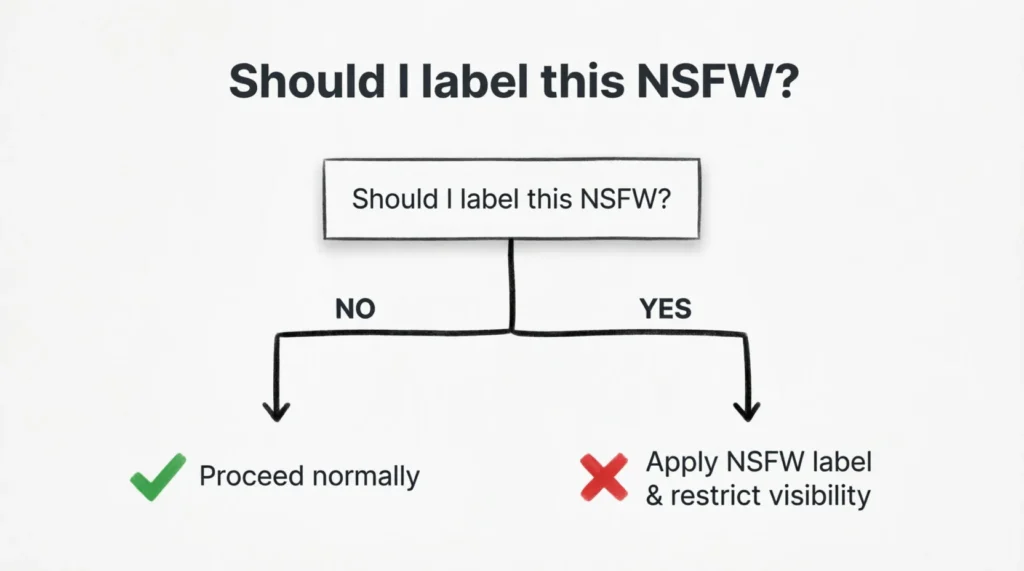
👉 Rule of thumb:
If you’d hesitate to open it in public, label it NSFW.
⚠️ Common Misunderstandings About NSFW
Let’s clear up a few myths:
❌ “NSFW always means porn”
Not true. It can also include:
- Dark humor
- Strong language
- Graphic news images
❌ “It’s only for work environments”
Nope. It also applies to:
- Schools
- Public places
- Family settings
❌ “People ignore it anyway”
Some do — but many rely on it to avoid awkward situations.
❌ “It’s not important”
Actually, it’s a big part of online etiquette.
💡 Pro Tips for Using NSFW Like a Pro
Want to use it correctly and confidently? Here’s how:
🔥 1. Always Place It Before the Content
“NSFW: This video is wild”
Not after — people need the warning first.
🔥 2. Be Honest
Don’t label something NSFW just for attention.
🔥 3. Combine with Context
“NSFW (language)”
This helps people know what to expect.
🔥 4. Respect Your Audience
Different people have different comfort levels.
🔥 5. When in Doubt, Use It
It’s better to over-warn than under-warn.
❓ FAQ:
1. Is NSFW only about adult content?
No. It includes anything inappropriate for public or professional settings, including violence or offensive language.
2. What is the opposite of NSFW?
The opposite is SFW (Safe For Work) — content that’s appropriate everywhere.
3. Can NSFW get you in trouble?
Yes. Viewing or sharing NSFW content in workplaces or schools can lead to warnings or disciplinary action.
4. Is NSFW the same as 18+?
Not exactly. 18+ is strictly age-based, while NSFW is about situational appropriateness.
🧾 Final Thoughts:
NSFW isn’t just slang it’s a social signal.
- Avoid awkward moments
- Stay professional
- Navigate online content safely
In a world where everything is just one click away, a simple NSFW can save you from a lot of regret 😅
So next time you’re about to share something questionable.
Would I open this in front of my boss or family?
If the answer is no you know what to do
Discover more post:
